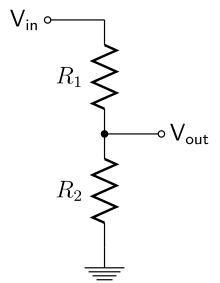
The Voltage Divider in electronics is a passive linear circuit that produces an output voltage that is a fraction of its input voltage. Voltage division is a result of distributing the input voltage among the components of the divider. A simple example of a voltage divider is two resistors connected in series, with the input voltage applied across the resistor pair and the output voltage emerging from the connection between them.
Resistor voltage dividers are commonly used to create reference voltages, or to reduce the magnitude of a voltage so it can be measured, and may also be used as signal attenuators at low frequencies. For direct current and relatively low frequencies, a voltage divider may be sufficiently accurate if made only of resistors; where frequency response over a wide range is required (such as in a oscilloscope probe), a voltage divider may have capacitive elements added to compensate load capacitance . In electric power transmission, a capacitive voltage divider is used for measurement of high voltage.
The following formula is used to calculate the voltage divider: `V_"out"=V_"in"(R_1/(R_1+R_2))`, where:
- `V_"in"` = input voltage
- `R_1` = resistance 1
- `R_2` = resistance 2
References
Wikipedia (https://en.wikipedia.org/wiki/Voltage_divider)